20 Best Freight Management Companies in the USA (The Ultimate Logistics Guide)
Posted On 17th June 2026Outsourcing commercial supply chain operations to professional freight management companies allows modern enterprises to eliminate distribution bottlenecks, scale seasonal capacity, and leverage pre-negotiated volume tariffs.
Selecting the correct transportation logistics company depends entirely on your specific equipment requirements, warehouse nodes, and software integrations.
If your team needs to route standard palletized cargo right now, you can secure immediate freight transport services through our automated LTL freight shipping platform.
The Logistics Selection Matrix
When evaluating modern freight management services, top providers are split into three distinct models based on their physical asset footprint and operational scope.
- Asset-Light Digital Brokers: Best for small to mid-sized shippers requiring immediate spot-market capacity and flexible lane routing across diverse freight carrier companies.
- Asset-Heavy 3PL Entities: Best for long-term contract logistics, raw material manufacturing support, and dedicated warehousing infrastructure.
- Integrated Lead Logistics Providers (4PLs): Best for complex global supply chains requiring an overarching partner to oversee multiple carriers, international forwarders, and custom systems.
.jpg)
Top 20 Freight Management Companies in the USA (2026 Fleet Index)
This master directory matches the nation's leading freight management services by their operational model, asset type, and primary logistical specialization.
| Rank | Freight Management Company | Primary Operational Model | Industry Core Specialization | Headquarters |
|---|---|---|---|---|
| 1 | FreightRun | Asset-Light Marketplace | Small Business LTL and FTL Spot Rating | Danbury, CT |
| 2 | C.H. Robinson | Non-Asset Digital Broker | High-Volume North American Truckload | Eden Prairie, MN |
| 3 | Total Quality Logistics (TQL) | Non-Asset Brokerage | 24/7/365 On-Demand Spot Capacity | Cincinnati, OH |
| 4 | J.B. Hunt Transport Services | Asset-Heavy 3PL | Intermodal Rail and Dedicated Fleets | Lowell, AR |
| 5 | UPS Supply Chain Solutions | Integrated Multi-Modal | Healthcare Logistics and Forwarding | Atlanta, GA |
| 6 | FedEx Logistics | Integrated Multi-Modal | High-Speed Express and Air Cargo | Memphis, TN |
| 7 | XPO Logistics | Asset-Heavy Pure Play | Industrial Less-Than-Truckload (LTL) | Greenwich, CT |
| 8 | Worldwide Express (WWEX) | Non-Asset Management | Mid-Market and SMB Group Tariffs | Dallas, TX |
| 9 | CEVA Logistics | Global Lead Logistics (4PL) | Automotive and Finished Vehicle Logistics | Houston, TX |
| 10 | Echo Global Logistics | Tech-Enabled Management | Managed TMS and Self-Service Portals | Chicago, IL |
| 11 | Ryder Supply Chain Solutions | Asset-Heavy Contract 3PL | Fleet Leasing and Manufacturing Logistics | Miami, FL |
| 12 | Schneider National | Asset-Heavy Fleet | Bulk Chemical and Orange-Fleet Truckload | Green Bay, WI |
| 13 | Arrive Logistics | Tech-Enabled Brokerage | High-Visibility Spot-Market Hauling | Austin, TX |
| 14 | RXO Logistics | Non-Asset Tech Broker | Digital Freight Matching and App Scaling | Charlotte, NC |
| 15 | NFI Industries | Asset-Heavy Contract 3PL | Dedicated Fleet Operations and Cross-Docking | Camden, NJ |
| 16 | Expeditors International | Non-Asset Global Forwarder | High-Value Air and Ocean Customs Clearance | Seattle, WA |
| 17 | Hub Group | Multi-Modal Powerhouse | Intermodal Logistics and Final-Mile Delivery | Oak Brook, IL |
| 18 | GEODIS North America | Global Lead Logistics (4PL) | E-commerce Fulfillment and Warehousing | Brentwood, TN |
| 19 | Penske Logistics | Asset-Heavy Contract 3PL | Cold-Chain Logistics and JIT Automotive | Reading, PA |
| 20 | Werner Logistics | Asset-Backed Management | Cross-Border Mexico Lanes and Flatbeds | Omaha, NE |
What Is a Freight Management Company?
A freight management company is a specialized third-party logistics provider that plans, optimizes, executes, and audits a shipper's transportation network on their behalf. Unlike a traditional transactional broker, an enterprise freight transport company integrates directly into your business operations to oversee your entire shipping framework.
When evaluating options among shipping and logistics companies, your chosen partner must successfully coordinate all 7 Pillars of Logistics to maximize supply chain efficiency:
- The Right Product: Ensuring structural cargo integrity through proper staging and trailer classification.
- The Right Quantity: Maximizing space utilization to ensure inventory counts match shipping manifests.
- The Right Condition: Mitigating product damage through strict cargo protection and packaging standards.
- The Right Place: Managing route optimization to ensure seamless delivery to the final dock or jobsite.
- The Right Time: Eliminating carrier delays to maintain strict warehouse arrival windows.
- The Right Customer: Providing clear tracking updates and automated proof of delivery documents.
- The Right Cost: Lowering total transportation expenses by eliminating hidden broker margins and unexpected accessorial fees.
Freight Management Companies vs. Freight Forwarders
A common source of confusion in enterprise logistics is distinguishing between a standard freight forwarder and a comprehensive freight management company. While both entities coordinate commercial cargo transportation, their operational scope is completely different.
A freight forwarder operates primarily as an intermediary specializing in asset booking, documentation preparation, and international customs clearance for specific transit legs, such as air or ocean lanes. Shippers can access a comprehensive list of freight carriers or run a comparison to match seasonal international capacities.
For highly complex international lanes that require strict maritime compliance, partnering with top freight forwarders in the USA ensures your documentation meets international entry requirements.
Conversely, a freight management company handles end-to-end transport freight services. Instead of simply booking a single lane, they handle your entire supply chain infrastructure, including inventory storage, cross-dock picking, billing consolidation, and post-delivery freight bill auditing.
20 Best Freight Management Companies in the USA
To assist your procurement team, we have categorized the leading domestic freight management services by their primary operational models and network advantages.
1. Market Leaders in Non-Asset Freight Management
These non-asset freight transport companies operate massive digital matching networks, pooling thousands of independent carrier tariffs into centralized interfaces to secure spot capacity instantly.
FreightRun: A technology-first freight marketplace that aggregates institutional tariffs across North America's top carriers into a single screen, providing small businesses with instant enterprise-level discounts.
C.H. Robinson: The largest non-asset freight transport company in North America, controlling massive spot-market freight volumes across dry van, flatbed, and temperature-controlled divisions.
Total Quality Logistics (TQL): A high-touch, 24/7/365 truckload broker recognized for aggressive lane sourcing and high-volume regional capacity procurement.
Worldwide Express (WWEX): Specializes in small-to-medium business logistics management, packaging deep regional carrier discounts together on a centralized platform.
Echo Global Logistics: A tech-forward freight manager offering automated transportation management software and self-service interfaces for everyday enterprise shippers.
Arrive Logistics: Known for tech-enabled premium tracking support, balancing strong contract lanes with reliable spot-market truckload fulfillment.
RXO Logistics: A tech-driven platform focusing on high-density digital freight matching, specialized brokerage lanes, and asset-light truckload distribution.
Uber Freight: A digital-first marketplace utilizing real-time algorithmic pricing and automated load matching to streamline carrier procurement.
2. Asset-Heavy Trucking and Shipping Companies
These asset-heavy transport freight companies own massive physical tractor-trailer fleets, distribution real estate, and rail container systems, providing ironclad capacity security.
J.B. Hunt Transport Services: A major intermodal pioneer, controlling the largest private 53-foot container fleet in the country to bridge rail spurs with highway networks. Shippers can review our deep dive on the largest trucking companies in the USA to evaluate specific asset configurations.
XPO Logistics: A dominant pure-play asset provider focused heavily on industrial less-than-truckload distribution and regional terminal optimization.
Ryder Supply Chain Solutions: Combines commercial fleet leasing operations with advanced contract warehousing, specialized sequencing, and raw manufacturing plant support.
Schneider National: A premier orange-fleet provider handling high-density truckload, bulk chemical transport, and intermodal lanes across North America.
NFI Industries: A massive family-owned 3PL managing automated cross-dock distribution facilities alongside an extensive dedicated contract truck fleet.
Penske Logistics: Highly regarded for cold-chain management, dedicated contract carriage, and complex multi-tier warehouse design.
Werner Logistics: Leverages a massive asset-based fleet to support retail replenishment networks, cross-border Mexico lanes, and specialized flatbed logistics.
3. Global Lead Logistics Providers (4PL) and Supply Chain Integrators
These enterprise conglomerates are frequently evaluated within the
CEVA Logistics: A dominant tier-one global logistics provider operating in over 170 countries with more than 110,000 employees, specializing in end-to-end supply chain integration, finished-vehicle logistics, and premium project-cargo management, operating as a leading subsidiary under the maritime asset umbrella of the
Expeditors International: A premium non-asset global forwarder focused heavily on highly structured time-definite air freight lanes and complex customs compliance.
Hub Group: A multi-modal powerhouse specializing in asset-backed intermodal logistics, final-mile delivery networks, and transactional broker solutions.
GEODIS North America: A global logistics leader recognized for extensive contract warehousing footprints, e-commerce fulfillment integration, and international air-sea freight optimization.
DSV North America: A massive global network operator handling complex industrial project cargo, aerospace logistics, and high-volume international trade lanes.
How Much Do Freight Management Services Cost?
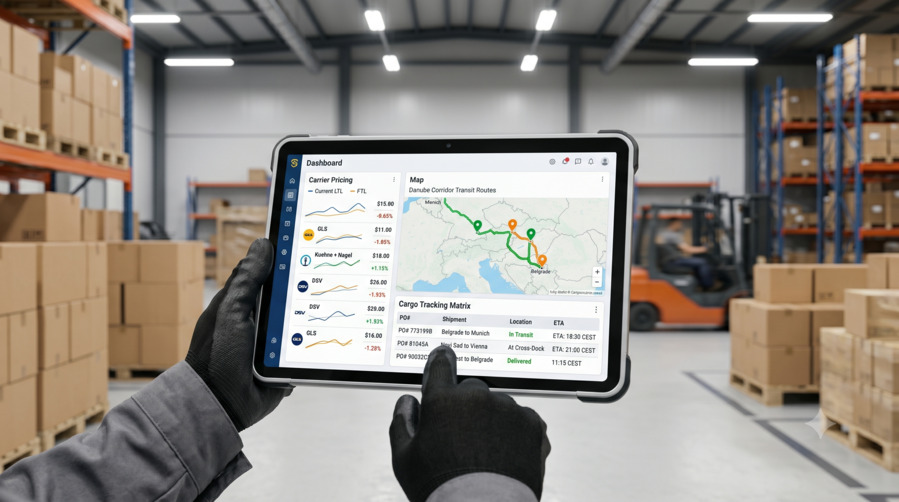
Unlike transactional freight brokers who add a variable percentage markup directly onto a carrier's haul rate, professional freight management companies operate under transparent service fee structures. This structural difference provides full visibility into the actual, unmarked-up carrier tariffs. Freight management pricing generally follows three core models:
- Management Service Fees: The provider issues a formal RFQ to negotiate direct contract rates with asset carriers on your behalf, passes the raw carrier rates to you, and charges a transparent management service fee.
- Subscription Tiered Pricing: Shippers pay a flat monthly or annual software licensing fee to utilize the provider's proprietary Transportation Management System (TMS), allowing internal staff to self-manage shipments without transactional broker overhead.
- Gainshare Pricing Models: The logistics manager analyzes your historical transport spend, identifies inefficiencies, and restructures your routing grid. Their compensation is directly tied to an agreed-upon percentage of verified financial savings they generate for your company.
Choosing the Right Partner: Questions to Ask Before Hiring
To safeguard your logistical margins, your procurement team must thoroughly interview a prospective provider before signing a master service agreement.
Operational and Compliance Vetting Questions
- What is your active safety rating with the Federal Motor Carrier Safety Administration, and what cargo insurance limits do you maintain?
- How does your platform handle retroactive carrier billing adjustments, weight corrections, or classification disputes?
- Do you operate as a pure asset-light broker, or do you maintain dedicated physical equipment capacities to guarantee lane coverage during seasonal capacity spikes?
Pre-Shipment Footprint Validation
Before sending your final product manifests to an automated management interface, verify the physical dimensions of your pallets to preserve your financial margins.
- Use our interactive linear-feet calculator to balance exact trailer configurations ahead of dispatch.
- For complex volumetric stackability audits, our cubic feet calculator ensures proper space allocation.
- If your freight is density-rated, run your dimensions through our density calculator to confirm your exact NMFC classification code and prevent auditing corrections.
Frequently Asked Questions
What is the core difference between a freight broker and a 3PL?
A standard freight broker focuses strictly on matching individual shippers with third-party carriers for transactional, point-to-point shipments. A third-party logistics company (3PL) provides end-to-end supply chain management, offering long-term contract warehousing, inventory control, and comprehensive fleet management solutions.
How do I find clients as a freight forwarder?
Successful forwarders secure B2B clients by targeting high-volume commodity manufacturers, international trade-lane operators, and e-commerce companies that require specialized customs clearance. Leveraging automated digital freight quote systems, establishing active profiles within global freight networks, and providing complete pricing transparency are the fastest paths to expanding a forwarder's client base.
What document acts as the legal contract between the shipper and the carrier?
The primary legal contract governing over-the-road freight is the bill of lading (BOL), which details cargo weight, description, and destination points. Shippers can consult our master bill of lading template guide to review regulatory tracking parameters and avoid mid-transit delays.
Centralize Your Corporate Freight Management with FreightRun
Navigating separate carrier contracts, auditing individual invoices, and jumping between tracking screens introduce unnecessary risks into your supply chain.
FreightRun consolidates your entire logistical footprint into one powerful, easy-to-use digital marketplace. Whether you need dedicated FTL freight shipping pipelines or streamlined multi-carrier options, we connect your business directly with the nation's premier asset networks on a single platform.
