Top 10 Freight Forwarders in the USA
Posted On 10th December 2025Updated 19/05/26
Every single day, thousands of tons of cargo move across the United States. Navigating tight supply chain deadlines, volatile fuel surcharges, and strict customs clearance requires a strategic logistics partner.
Whether you need to scale ocean container imports on transpacific lanes, secure urgent international air freight capacity, or manage domestic cross-border distribution, selecting the right partner is critical.
This 2026 guide reviews the largest freight forwarding companies operating in the US, ranked by operational volume, core strengths, and service footprint.
List of the Largest Freight Forwarders in the USA
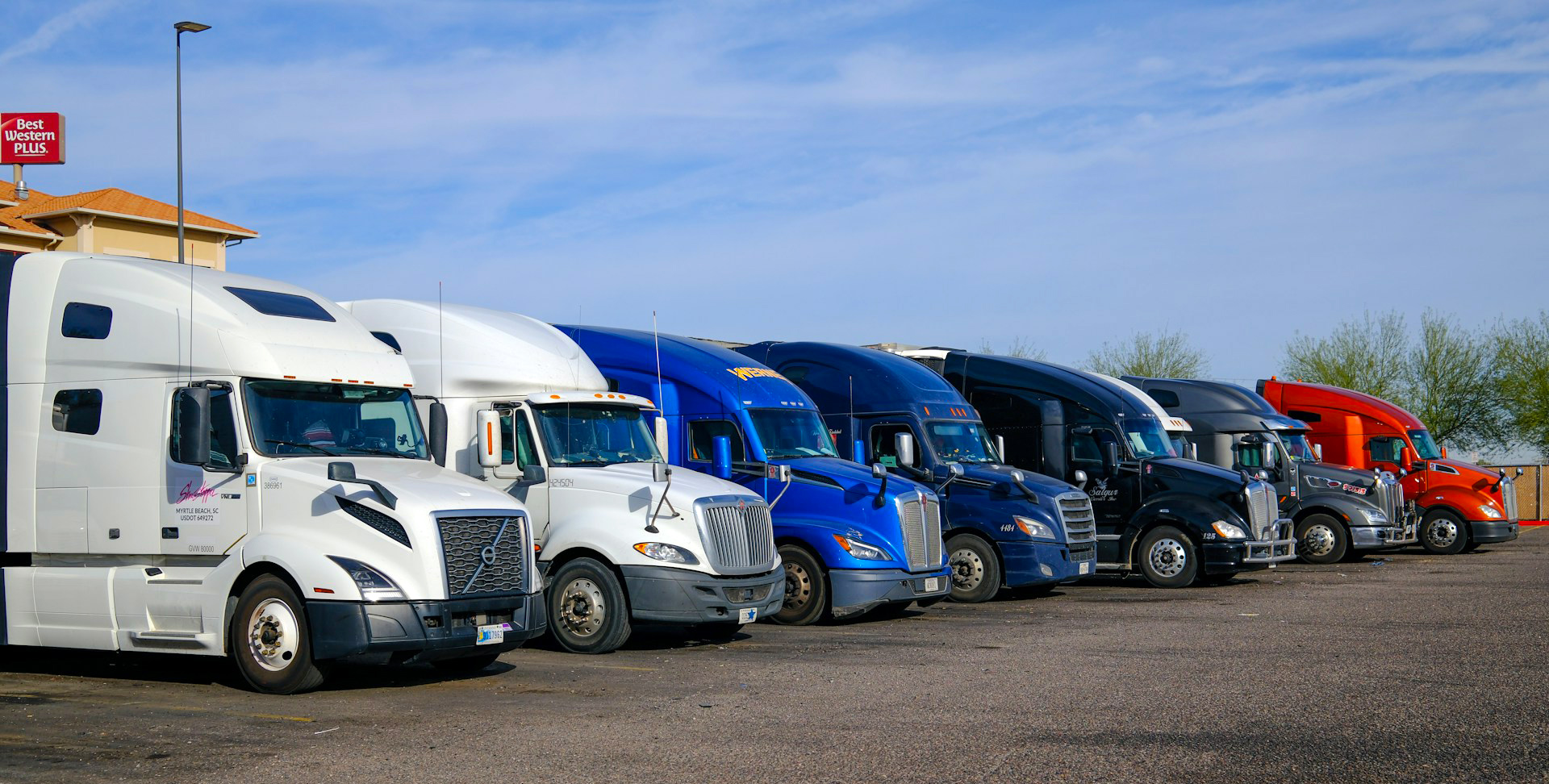
Choosing a logistics provider involves weighing global scale against localized US infrastructure. The following top-tier cargo forwarding companies are ranked by their total ocean and air shipment volumes, domestic networks, and industry metrics, as reported by Armstrong & Associates.
| # | Freight Forwarder in the USA | Primary Transit Focus | Core Logistics Strengths |
|---|---|---|---|
| 1 | Kuehne + Nagel | Ocean & Air Freight | Global volume leader in ocean TEUs; exceptional end-to-end supply chain visibility. |
| 2 | DSV (incl. DB Schenker) | Ocean, Air, & Road | Dominant European-US lanes, massive contract logistics, and intermodal networks. |
| 3 | DHL Global Forwarding | Air Freight & Customs | Unrivaled international customs brokerage and global pharma cold-chain networks. |
| 4 | C.H. Robinson | Domestic FTL/LTL | Largest North American freight broker; elite cross-border Mexico/Canada capacity. |
| 5 | Expeditors International | Time-Critical Air | Asset-light, agile model specializing in expedited air freight and compliance. |
| 6 | Nippon Express | Ocean & Air Freight | Transpacific trade lane leader specializing in precision automotive and high-tech manufacturing logistics. |
| 7 | UPS Supply Chain Solutions | Air & Parcel Forwarding | Integrated global shipping with massive domestic distribution and final-mile infrastructure. |
| 8 | CEVA Logistics | Ocean Freight & 3PL | Strong integration with major ocean carriers (CMA CGM) and specialized contract warehousing. |
| 9 | Sinotrans | Ocean Freight | Massive container volume capacity directly targeting China-to-USA manufacturing lanes. |
| 10 | Flexport | Digital Forwarding | Digital-first platform optimized for real-time tracking and modern enterprise ERP integrations. |
Shipper’s Tip: While enterprise mega-forwarders handle major port-to-port movements, securing immediate, competitive domestic capacity requires a flexible platform. Shippers can instantly compare live asset-carrier rates using the FreightRun Quote Tool.
Deep-Dive Profiles of the Top 10 US Freight Forwarders
1. Kuehne + Nagel
- Headquarters: Schindellegi, Switzerland (US Hub: Jersey City, NJ)
- Core Specialties: Transatlantic and Transpacific ocean lanes, pharmaceutical cold-chains, and aerospace logistics.
- Pros: Top global ocean freight capacity; robust tracking via the MyKN platform.
- Cons: Enterprise-focused structures can lack flexibility for mid-market shippers.
2. DSV (including DB Schenker)
- Headquarters: Hedehusene, Denmark (US Hub: Clark, NJ)
- Core Specialties: Automotive logistics, heavy industrial engineering, and large project cargo.
- Pros: Unmatched multimodal transit capabilities following the integration of DB Schenker.
- Cons: Massive, ongoing corporate integrations can lead to shifts in account management.
3. DHL Global Forwarding
- Headquarters: Bonn, Germany (US Hub: Miami, FL)
- Core Specialties: Urgent international air freight, hazardous materials (HazMat), and regulatory customs compliance.
- Pros: Elite in-house customs clearance networks spanning global border checkpoints.
- Cons: Premium pricing tiers for standard, non-expedited commercial cargo.
4. C.H. Robinson
- Headquarters: Eden Prairie, MN
- Core Specialties: High-volume North American drayage, domestic truckload (FTL), and Less-Than-Truckload (LTL) shipping.
- Pros: Massive domestic carrier network; fluid cross-border lanes between Mexico and Canada.
- Cons: Global ocean and air cargo capacity is smaller than that of European competitors.
5. Expeditors International
- Headquarters: Seattle, WA
- Core Specialties: Technology hardware, retail fashion, and high-value electronics.
- Pros: Asset-light model guarantees high agility and customizable routing protocols.
- Cons: Complete reliance on third-party carrier execution during peak market capacity constraints.
6. Nippon Express
- Headquarters: Tokyo, Japan (US Hub: New York, NY)
- Core Specialties: Just-in-time (JIT) manufacturing supply chains and semiconductor logistics.
- Pros: Deep origin infrastructure, equipment, and port access across major Asian markets.
- Cons: Lower operational lane density across European and South American corridors.
7. UPS Supply Chain Solutions
- Headquarters: Atlanta, GA
- Core Specialties: High-volume e-commerce fulfillment, bulk container de-consolidation, and retail distribution.
- Pros: Flawless closed-loop integration from overseas factories straight to residential doors.
- Cons: Rigid and bureaucratic pricing models for out-of-gauge or non-standard freight.
8. CEVA Logistics
- Headquarters: Marseille, France (US Hub: Houston, TX)
- Core Specialties: Consumer retail volumes and heavy-industrial energy-sector infrastructure.
- Pros: Parent company relationship with ocean carrier CMA CGM secures stable vessel allocations.
- Cons: Historical market fluctuations within their independent global air freight division.
9. Sinotrans
- Headquarters: Beijing, China (US Hub: Los Angeles, CA)
- Core Specialties: Bulk manufacturing exports, raw industrial commodities, and origin consolidation.
- Pros: Unrivaled logistics dominance and factory coordination across Chinese export ports.
- Cons: Local customer service infrastructure inside the United States is less extensive.
10. Flexport
- Headquarters: San Francisco, CA
- Core Specialties: Direct-to-Consumer (DTC) brands, digital supply chain tracking, and API system integrations.
- Pros: Automated tracking dashboard that integrates with enterprise ERPs (SAP, Oracle, NetSuite).
- Cons: Lacks the physical asset footprint and owned maritime infrastructure of legacy forwarders.
Ocean Freight Forwarders vs. Air Freight Companies
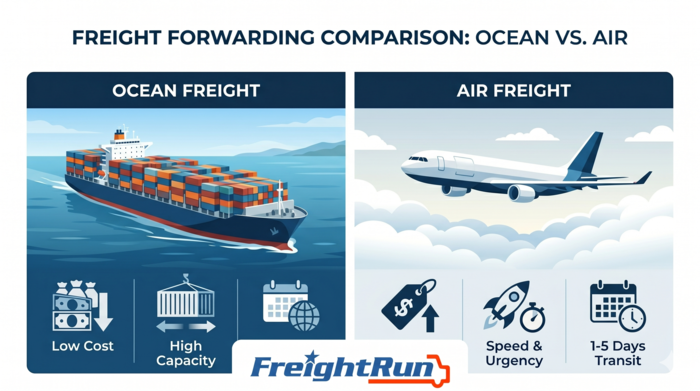
Choosing the best freight forwarder in the USA requires matching your operational timeline to the correct transportation mode:
- Ocean Freight Forwarding: Designed for high-volume, heavy cargo including general commercial goods, palletized retail products, and industrial machinery. It is the most cost-effective option, but requires significant lead time planning due to ocean transit schedules.
- Air Freight Companies: Reserved for high-value, urgent, or highly perishable cargo. While air transport significantly slashes transit times, it commands premium pricing.
Instead of navigating these multi-billion-dollar forwarders for localized freight legs, smart shippers use FreightRun to bypass corporate bureaucracy and gain instant access to both regional and national carriers for immediate booking.
International Shipping, Customs, and Warehouse Delivery
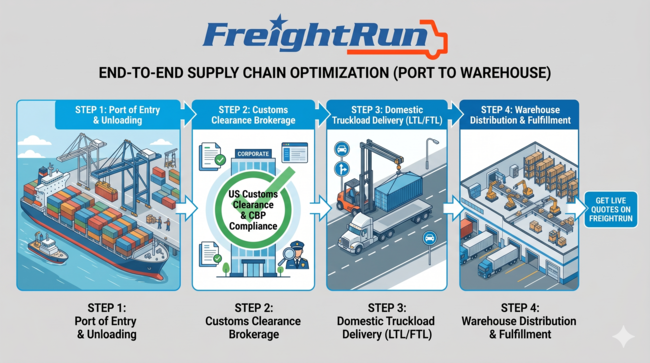
Importing goods into the US involves complex legal requirements. International freight carriers manage the physical movement of goods, but a critical bottleneck occurs at the port of entry.
For efficient operations, shippers must coordinate with forwarders that handle customs clearance and final delivery to warehouse facilities. The forwarder manages the Harmonized System (HS) tariff classification, files entries with the U.S. Customs and Border Protection (CBP), and pays the necessary duties.
Once cleared, the cargo must be moved swiftly via domestic LTL (Less-Than-Truckload) or FTL (Full Truckload) networks to your designated 3PL warehouse, fulfillment center, or retail hub.
Import Pipeline: [Port of Entry] → [Customs Clearance (CBP)] → FreightRun LTL/FTL Network → [Your Warehouse]
This final domestic leg is where shippers often overpay. Use the FreightRun platform to compare competitive domestic truckload quotes and save up to 30% on land transport.
Regulatory Compliance Checklist
To protect your inventory from non-compliant or fraudulent operators, always verify that your logistics provider holds active credentials with federal and international regulatory bodies:
- FMC Licensing: Ensure the provider is registered with the Federal Maritime Commission via the FMC OTI Public Lookup for legal ocean forwarding.
- NVOCC Status: Non-Vessel Operating Common Carriers can issue their own Bills of Lading, giving you direct legal protection over your cargo.
- IATA Accreditation: Confirm that air freight agents are verified in the IATA Directory to ensure compliance with global aviation safety standards.
- C-TPAT Certification: Active participation in the Customs-Trade Partnership Against Terrorism reduces border inspection delays and accelerates customs clearance.
Frequently Asked Questions
What is a freight forwarder?
A freight forwarder is a logistics company that organizes shipments for individuals or corporations, moving goods from manufacturers to final markets. They do not move the freight themselves but act as an expert network, booking space on ships, airplanes, or trucks while managing the required shipping documentation.
How do I compare the best freight forwarding companies?
Evaluate forwarders based on your specific route volumes and cargo types. A company shipping heavy machinery requires a forwarder specializing in out-of-gauge ocean freight, while a medical supplier needs an air freight forwarder that strictly complies with temperature-control requirements. Verify their ocean shipping license with the Federal Maritime Commission (FMC).
What is the difference between a freight forwarder and a 3PL?
A freight forwarding service focuses primarily on the transportation execution, documentation, and port-to-port cargo movement. A full Third-Party Logistics (3PL) provider manages the broader supply chain ecosystem, overseeing long-term warehouse storage, pick-and-pack fulfillment, and direct consumer delivery.
Instantly Compare US Shipping Rates for Your Business
Don’t let manual quotes delay your supply chain. Whether you are picking up cleared cargo from a US port or shipping freight across North America, you need transparent, live market pricing.
With FreightRun.com, you eliminate the guesswork. Our platform lets you view, analyze, and compare live LTL, FTL, and parcel quotes side by side from the country’s most reliable asset carriers.
Use the FreightRun Quote Calculator Now — Get Your Freight Quote in Under 60 Seconds
