
How to Ship Ammo Legally Without Violating Carrier Regulations
Posted On 9th July 2020Transporting small-arms cartridges through the domestic logistics framework requires a thorough understanding of federal safety regulations, state-level consumer bans, and individual carriers' tariffs.
Because ammunition contains explosive propellants and chemical primers, the U.S. Department of Transportation (DOT) classifies it as a hazardous material.
If you violate hazardous materials regulations or try to slip cartridges into restricted transport pipelines, you risk facing severe federal civil penalties, confiscation, and felony charges.
Before coordinating high-volume shipments or liquidating a private storehouse, you can easily verify bulk logistics lanes and equipment constraints using our national
Check out our other services:
- Oversize Load Trucking
- Refrigerated LTL
- Heavy Machinery Transport
- Heavy Equipment Transport
- LTL Freight Shipping Services
Before shipping regulated items, it’s helpful to compare freight carrier rates online.
Can You Ship Ammo to Your House? (Federal Law vs. State Restrictions)
Can you ship ammo to your house?
Yes. Under federal law, private individuals and commercial retailers are legally permitted to ship small arms ammunition directly to a consumer’s residential home address without routing the package through a Federal Firearms License (FFL) holder. You do not need a federal permit or an absolute concealment license to ship standard commercial cartridges over the road.
However, state-level legislation varies drastically. Several strict jurisdictions completely override federal baselines, making it illegal to ship ammunition directly to a private residence:
- California (Proposition 63): All consumer ammunition shipments must be delivered directly to a state-licensed ammunition vendor or FFL holder. For a complete list of exemptions and eligibility requirements, check the
- New York, Massachusetts, and Washington, D.C.: Direct-to-consumer online sales and home deliveries of ammunition are heavily restricted or prohibited; packages must pass through state-approved licensees.
- Illinois: Shippers can only fulfill direct-to-home orders if the buyer submits a scanned, verified copy of their state-issued Firearm Owner’s Identification (FOID) card along with a matching government-issued ID.
Carrier Rules: Shipping Ammo via USPS, UPS, and FedEx
Selecting the proper logistics partner is the most critical compliance step when evaluating how to ship ammo.
1. Can you mail ammo USPS?
Absolutely not. The United States Postal Service maintains an absolute, ironclad ban on transporting any form of live ammunition, gunpowder, or explosive primers.
Felony Warning: Attempting to hide ammunition inside a package sent via First-Class, Priority, or Express Mail is a federal felony violation under 18 U.S.C. § 1716. Shippers can read the statutory penalties detailed
2. Shipping Ammo UPS (The Consumer-Friendly Choice)
UPS is widely preferred by individual shippers because it permits walk-in consumer hazardous material transport without a pre-approved business contract, provided you follow these specific guidelines:
- Approved Intakes Only: You cannot drop ammo into a UPS Drop Box, nor can you tender packages to independent franchises like The UPS Store or third-party Access Points. You must hand the package directly to an employee at an official UPS Customer Center located inside an active hub facility, or use an established business pickup account.
- Strict Weight Limits: The total weight of a single package cannot exceed 66 pounds (30 kg).
- Ground Transit Only: Ammunition can only travel via UPS Ground within the 48 contiguous United States. Air shipping tiers (Next Day Air, 2-Day Air) are strictly prohibited.
- Caliber Restrictions: Eligible cartridges are limited to small arms ammunition under 12.7 mm (.50 caliber) or standard shotgun shells down to 8 gauge.
3. Shipping Ammo FedEx (Commercial Account Required)
While FedEx offers excellent reliability, its hazard guidelines are strictly tailored toward commercial shippers:
- Mandatory Contract: Unlike UPS, FedEx requires individuals to have a pre-approved, formal hazardous materials shipping agreement in place before tendering any ammunition.
- Location Dropping Limitations: You cannot drop ammunition packages at FedEx Office locations, FedEx Ship Centers, or unstaffed drop boxes. All hazmat boxes must be processed via a scheduled pickup at an approved customer location.
- Service Rules: Shipments must move via FedEx Ground pipelines within the contiguous United States. Air cargo routes to Alaska or Hawaii are prohibited to mitigate risks associated with altitude and pressure.
Modern Packaging and Labeling Laws (The Death of ORM-D)
When packaging small arms cartridges, you must follow strict structural rules to prevent accidental discharges or box failures during over-the-road transit:
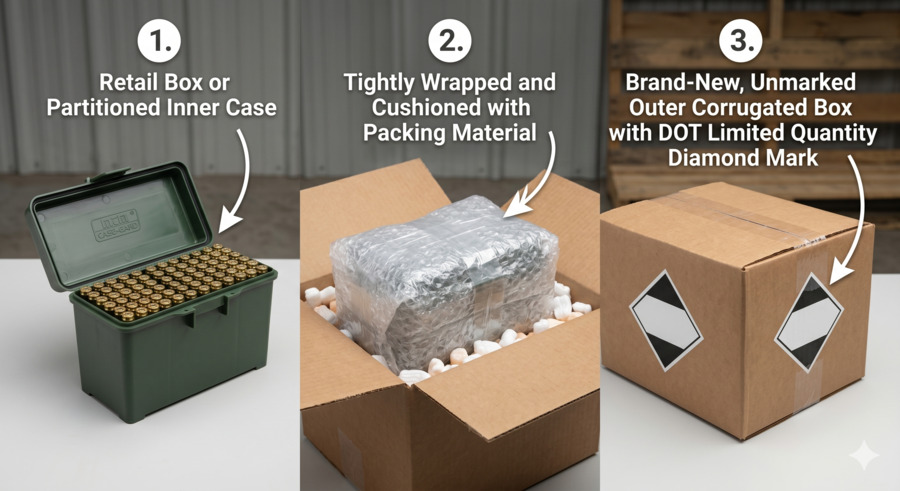
1. Structural Inner and Outer Containers
Ammunition can never be thrown loose inside a shipping box. Cartridges must be nested in their original manufacturer's retail packaging or secured inside partitioned fiberboard inner boxes or metal clips.
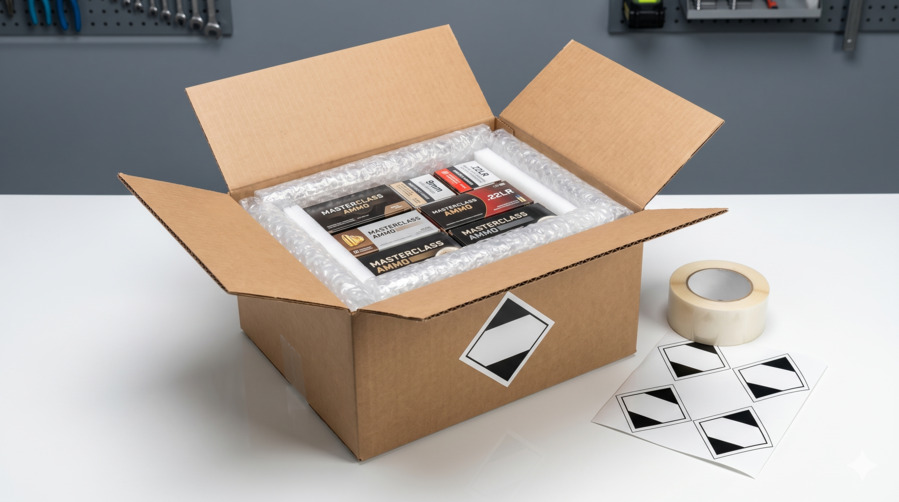
Place these inner boxes snugly inside a brand-new, unmarked corrugated outer box that meets single-wall strength guidelines. Pack any empty void space with bubble wrap until the box can be shaken without any internal movement.
2. The Obsolete ORM-D Label vs. The Modern Limited Quantity Mark
Critical Compliance Notice: The historical "ORM-D" (Other Regulated Materials-Group D) consumer label has been permanently phased out by the Department of Transportation and is illegal to use.
Every ammunition package must now feature the updated DOT Limited Quantity Diamond Mark applied to at least two opposing sides of the outer box. This mark is a clean square-on-point diamond with solid black top and bottom corners.
You can review the exact packaging allowances and reclassifications under the official
To help prevent theft, federal law prohibits writing the words "Ammunition" or "Bullets" anywhere on the outside of the box; the diamond mark serves as the sole hazardous identification symbol for terminal handlers.
| Shipping Label Type | Regulatory Compliance Status | Proper Legal Action Required |
| ORM-D Blue/White Stamp | COMPLETELY OBSOLETE / ILLEGAL | Do not use. Packages will be rejected at terminal checkpoints. |
| Limited Quantity Diamond | MANDATORY FOR ALL GROUND FREIGHT | Apply a 4x4-inch black-and-white diamond label to two separate faces. |
Frequently Asked Questions
Can you mail ammunition through FedEx if you are a private citizen?
You can only ship ammunition through FedEx if you possess an active, pre-approved commercial business account that holds a signed hazardous materials transportation agreement. Private individuals who do not maintain a contract should instead utilize an official UPS Customer Center to complete their consumer ground shipments.
How much does it cost on average to ship ammunition domestically?
Because ammunition must stay within standard ground transportation pipelines and has a high physical density, shipping costs generally track package weight rather than package size. A standard small box of cartridges (up to 8 lbs) costs roughly $25 to $35 across regional lanes, while bulk cases that meet the maximum 66-pound threshold can range from $60 to $90 depending on the total travel distance.
Can ammunition and firearms be packaged and shipped inside the same container?
No. Federal transportation law and carrier safety guidelines strictly prohibit packaging ammunition inside the same container as an operational firearm. If you are shipping a rifle or pistol to an FFL dealer for repair or sale, the weapon must be completely unloaded, and any accompanying cartridges must be packed and manifested in an entirely separate, isolated box with its own tracking number.
Mitigate Hazmat Transport Compliance Risks with FreightRun
Don't risk expensive compliance penalties, terminal distribution delays, or unexpected carrier rejections. FreightRun streamlines complex hazardous materials logistics by connecting your corporate team with commercial carriers that hold verified DOT hazardous materials safety permits.
