
Brooklyn NY to Saint Petersburg FL Freight Shipping Rates and Transit Times
Connecting the high-density commercial docks and distribution yards of Kings County, New York, with the rapidly growing Tampa Bay manufacturing and regional logistics district in Pinellas County forms a vital Eastern Seaboard freight pipeline. Spanning approximately 1,150 miles along the southern Atlantic corridor, this shipping lane carries steady volumes of manufactured goods, packaged food products, commercial fixtures, retail inventory, and building materials.
As part of our popular US shipping lanes directory, FreightRun coordinates with vetted regional and national LTL carriers operating daily line-hauls between the New York metropolitan area and the Florida Gulf Coast.
Get an Instant Free Freight Quote from Brooklyn to Saint PetersburgRoute Transit & Pricing Snapshot
Shipping Factor |
Route Benchmark Data |
Origin Hub |
Brooklyn, NY 11201 (Kings County / New York Harbor Logistics Complex) |
Destination Hub |
Saint Petersburg, FL 33701 (Pinellas County / Tampa Bay Distribution Basin) |
Total Route Distance |
Approximately 1,150 Miles |
Typical LTL Transit Window |
3 to 4 Business Days |
Historical Average LTL Rate |
$1,050 to $1,380 per standard commercial load |
Primary Route Line-Haul |
I-278 West to NJ Turnpike to I-95 South to I-4 West / I-75 South to I-275 South |
Corridor Routing & Practical Transit Factors
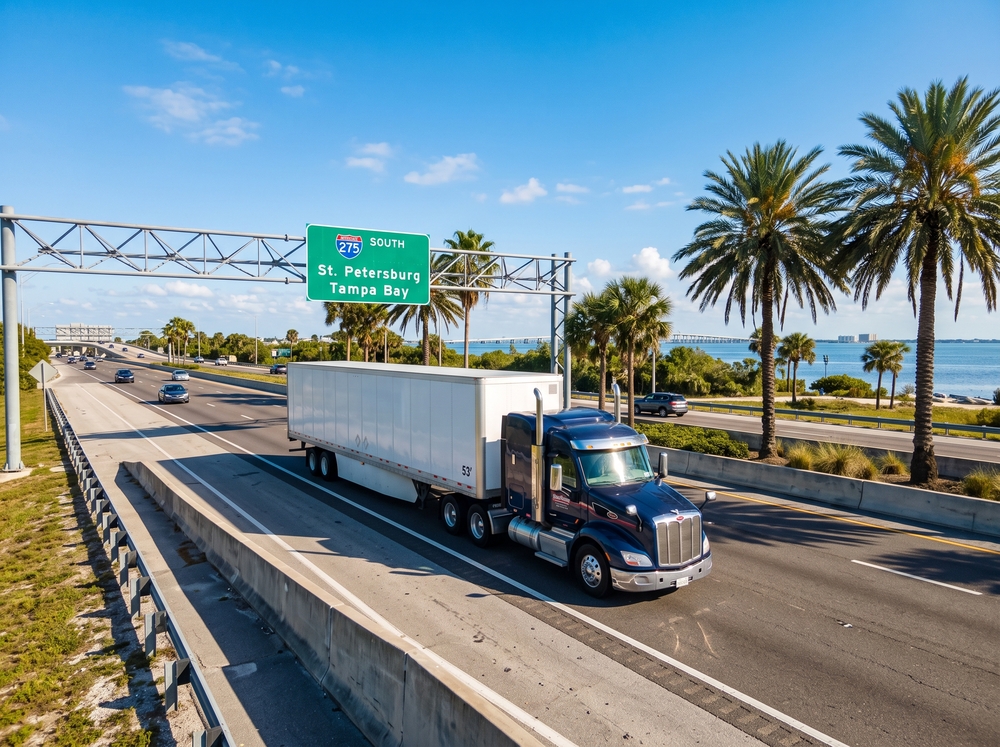
Commercial line-haul trucks departing Brooklyn travel along the Gowanus Expressway (I-278 West) across the Verrazzano-Narrows Bridge into New Jersey, then connect with the New Jersey Turnpike and continue south on Interstate 95. Carriers track the coastal interstate spine through the Mid-Atlantic and Carolinas into Northern Florida, then head west on Interstate 4 toward Tampa and cross the Howard Frankland Bridge on Interstate 275 South directly into the Saint Petersburg industrial peninsula.
- Urban Origin Navigation & Bridge Tolls: Commercial pickups across Brooklyn neighborhoods (such as Bushwick, Sunset Park, or Red Hook) face strict urban truck-route compliance requirements and heavy bridge tolls when leaving Long Island. Carriers typically dispatch smaller 28-foot pup trailers or straight trucks for initial pickup, then cross-dock onto 53-foot line-haul trailers at regional terminals in Northern New Jersey or Queens.
- Pinellas County Geographic Access: Saint Petersburg sits on a peninsula bounded by Tampa Bay and the Gulf of Mexico. Line-haul freight must enter via causeways and bridges along I-275 or Gandy Boulevard. Facilities in South St. Pete, Pinellas Park, or Clearwater often lack high-bay industrial docks, so hydraulic gate delivery is frequently required.
- Preventing Classification Billing Disputes: Because a wide variety of consumer goods, furniture, and specialty machinery move from New York to Florida, confirm the exact commodity classes and sub-codes using our NMFC code lookup tool before carrier dispatch.
- Florida Peninsula Capacity Balance: Because Florida inbound freight outpaces outbound manufacturing tonnage, carrier capacity into the Tampa Bay market is consistently sufficient. Scheduling morning dock appointments in St. Petersburg ensures offloading before afternoon bridge traffic in the area builds.
Selecting the Right Shipping Method
- Less-Than-Truckload (LTL): The most cost-effective option for shipping 1 to 6 commercial pallets. Choosing less-than-truckload shipping shares line-haul space across multiple shippers, keeping regional transportation budgets predictable.
- Partial Truckload (PTL): Recommended for 6 to 14 pallets of delicate machinery, non-stackable electronics, or retail displays. PTL keeps cargo on a single trailer from New York to Florida, eliminating mid-route cross-dock transfers and reducing claim risks.
- Full Truckload (FTL): For high-volume producers filling a standard 53-foot dry van or refrigerated trailer up to 45,000 lbs. Choose full truckload transport for direct door-to-dock transit reaching the Tampa Bay basin in approximately 2 road-driving days.
Official Transportation Resources
- New York State Department of Transportation (511NY) — Review real-time New York City bridge delays, commercial truck restrictions, and turnpike travel conditions.
- Florida Department of Transportation (FL511) — Monitor real-time highway speeds, I-4/I-275 construction alerts, and Tampa Bay bridge wind advisories.
- Federal Motor Carrier Safety Administration (FMCSA) — Verify interstate carrier operating authority, safety ratings, and active commercial liability coverage.
Frequently Asked Questions
How long does standard LTL freight take from Brooklyn to Saint Petersburg?
Standard LTL delivery typically takes 3 to 4 business days. A shipment dispatched from a Brooklyn dock on Monday morning generally reaches the Tampa Bay regional terminal for local straight-truck delivery between Thursday afternoon and Friday morning.
Can I arrange liftgate delivery for locations in Saint Petersburg?
Yes. If your receiving warehouse, commercial storefront, or distribution facility in Saint Petersburg lacks an elevated loading dock or forklift, select liftgate delivery during quoting so an equipped local bobtail handles final delivery.
How do I prevent freight re-weigh and classification adjustments?
Accurately measure dimensions from the base of the pallet to the tallest carton point, ensure there is no pallet overhang, and determine the exact density tier using standard freight class guidelines before recording certified scale weights on the Bill of Lading.
Compare Live Rates on the Brooklyn to Saint Petersburg Lane
Compare real-time rates and transit schedules from vetted regional and national carriers running between New York and the Florida Gulf Coast.
Compare Live Rates and Book Brooklyn to Saint Petersburg Freight