
Piqua OH to Los Angeles CA Freight Shipping Rates and Transit Times
Connecting the precision metal fabrication, high-pressure equipment, and industrial tooling base of Miami County, Ohio, with the nation’s premier consumer distribution and Pacific trade complex in Los Angeles County represents a critical transcontinental freight corridor. Covering approximately 2,200 miles across the American heartland and Southwest, this route moves continuous commercial shipments of aerospace components, automotive stampings, pumps, electrical hardware, retail replenishment inventory, and manufactured plastics.
As part of our popular US shipping lanes directory, FreightRun provides instant access to vetted regional and transcontinental carrier networks operating scheduled cross-country line-hauls between Western Ohio and the Greater Los Angeles metropolitan basin.
Get an Instant Free Freight Quote from Piqua to Los AngelesRoute Transit & Pricing Snapshot
Shipping Factor |
Route Benchmark Data |
Origin Hub |
Piqua, OH 45356 (Miami County / Dayton Industrial & Aviation Corridor) |
Destination Hub |
Los Angeles, CA 90001 (Los Angeles Basin / Inland Empire Distribution Complex) |
Total Route Distance |
Approximately 2,200 Miles |
Typical LTL Transit Window |
4 to 6 Business Days |
Historical Average LTL Rate |
$1,340 to $1,780 per standard commercial load |
Primary Route Line-Haul |
I-75 South to I-70 West to I-44 West to I-40 West to I-15 South into the LA Basin |
Corridor Routing & Practical Transit Factors
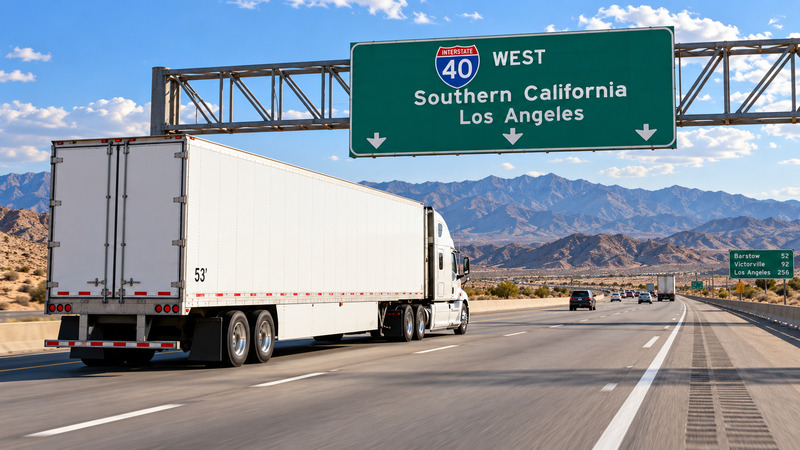
Commercial line-haul trucks departing Piqua link directly via Interstate 75 South into Dayton, connecting west along Interstate 70 through Indianapolis, St. Louis, and Kansas City (or cutting southwest via Interstate 44 through Oklahoma to Interstate 40 West across Texas, New Mexico, and Arizona). Freight crosses the Mojave Desert before navigating the Cajon Pass on Interstate 15 South directly into the Los Angeles and Inland Empire logistics complexes.
- Dayton Consolidation & Evening Line-Haul Gates: Piqua shippers benefit from proximity to major carrier hub terminals in Dayton and Vandalia. Scheduling morning pickups prior to 11:30 AM ensures freight reaches regional cross-docks in time to make evening westbound line-haul dispatches without rolling over to the next business day.
- Southwest Desert Heat & Mountain Passes: Transcontinental rigs traversing New Mexico, Arizona, and Southern California encounter high ambient summer temperatures exceeding 105°F (40°C), followed by steep highway grades through the Cajon Pass (elev. 3,777 ft). Shippers transporting temperature-sensitive sealants, industrial coatings, or delicate assemblies should request protect-from-heat or dedicated space.
- Preventing Classification Billing Adjustments: Manufactured equipment, steel machinery, and precision tooling moving out of the Miami Valley often feature high density but variable handling requirements. Confirm proper sub-classes and density tiers using our NMFC code lookup tool prior to carrier dispatch.
- Southern California Commercial Unloading: Delivery destinations across Los Angeles County, the San Gabriel Valley, and the South Bay frequently experience heavy commercial traffic and constrained yard footprints. Commercial sites lacking an elevated loading bay or forklift require dedicated hydraulic liftgate straight-truck delivery.
Selecting the Right Shipping Method
- Less-Than-Truckload (LTL): The most practical option for freight moving between 1 and 6 commercial pallets. Choosing less-than-truckload shipping shares line-haul trailer capacity with other commercial shippers, keeping long-haul freight costs economical.
- Partial Truckload (PTL): Best suited for 6 to 14 pallets of precision tooling, assembled machinery, or non-stackable freight. PTL keeps cargo on a dedicated trailer from Ohio to California without intermediate terminal re-handling.
- Full Truckload (FTL): For high-volume producers filling a standard 53-foot dry van or refrigerated trailer up to 45,000 lbs. Choose full truckload transport for direct door-to-dock transit reaching the West Coast in 3 to 4 business days.
Official Transportation Resources
- Ohio Department of Transportation (OHGO) — Review real-time Western Ohio highway speeds, I-75 work zones, and commercial travel advisories.
- California Department of Transportation (Caltrans QuickMap) — Monitor real-time Southern California highway conditions, mountain pass wind alerts, and truck lane restrictions.
- Federal Motor Carrier Safety Administration (FMCSA) — Verify interstate carrier operating authority, safety ratings, and active commercial liability coverage.
Frequently Asked Questions
How long does standard LTL freight take from Piqua to Los Angeles?
Standard cross-country LTL delivery typically takes 4 to 6 business days. A shipment dispatched from Piqua on Monday morning generally reaches the Los Angeles destination terminal for local straight-truck delivery between Friday afternoon and the following Tuesday morning.
Can I arrange liftgate delivery for commercial sites in Los Angeles?
Yes. If your receiving warehouse, fabrication shop, or commercial storefront in Los Angeles, Commerce, or Torrance lacks an elevated dock or forklift, select liftgate delivery during quoting so an equipped local straight truck handles final delivery.
How do I prevent freight re-weigh and classification adjustments?
Accurately measure dimensions from the base of the pallet to the tallest carton point, verify there is no packaging wrap overhang, and determine the exact density tier using standard freight class guidelines before recording certified scale weights on the Bill of Lading.
Compare Live Rates on the Piqua to Los Angeles Lane
Compare real-time rates and line-haul schedules from vetted regional and transcontinental carriers running between Western Ohio and Southern California.
Compare Live Rates and Book Piqua to Los Angeles Freight