
Dearborn MI to Apopka FL Freight Shipping Rates and Transit Times
Connecting the historic automotive engineering and heavy manufacturing capital of Wayne County, Michigan, with the expanding agricultural, commercial greenhouse, and distribution center of Orange County, Florida, forms a consistent North-South freight corridor. Spanning approximately 1,065 miles across the eastern interior, this lane handles ongoing shipments of automotive tooling, industrial replacement parts, manufactured plastic assemblies, retail inventory, and commercial greenhouse supplies.
As part of our popular US shipping lanes directory, FreightRun connects commercial shippers with vetted regional and national LTL carriers operating daily scheduled line-hauls between Metro Detroit and Central Florida.
Get an Instant Free Freight Quote from Dearborn to ApopkaRoute Transit & Pricing Snapshot
Shipping Factor |
Route Benchmark Data |
Origin Hub |
Dearborn, MI 48126 (Wayne County / Metro Detroit Automotive Basin) |
Destination Hub |
Apopka, FL 32703 (Orange County / Greater Orlando Logistics Nexus) |
Total Route Distance |
Approximately 1,065 Miles |
Typical LTL Transit Window |
2 to 4 Business Days |
Historical Average LTL Rate |
$980 to $1,280 per standard commercial load |
Primary Route Line-Haul |
I-75 South directly into Central Florida to Florida’s Turnpike / SR-429 North |
Corridor Routing & Practical Transit Factors
Commercial line-haul trucks departing from Dearborn link directly to southbound Interstate 75 via Interstate 94 or the Southfield Freeway (M-39). The route follows the primary north-south spine through Ohio, Kentucky, Tennessee, and Georgia, then enters Northern Florida and uses State Road 429 (Western Expressway) to reach the Apopka commercial distribution zone.
- Winter Freeze Protection Along the Northern Leg: While Central Florida remains warm year-round, line-haul trailers originating in Wayne County from late November through March encounter sustained subzero temperatures across Michigan and Ohio. For water-based industrial coatings, adhesives, or temperature-sensitive chemicals, a protect-from-freeze service prevents cargo loss during cross-dock transfers in Cincinnati or Atlanta.
- Jellico Mountain & Cumberland Plateau Elevation: Trailers traveling through Kentucky and Tennessee traverse the rolling grades of Jellico Mountain on I-75. Securing pallets with straps and wrap prevents load shifting during mountain climbs and descents.
- Preventing Classification Billing Adjustments: Given the high density of automotive parts, stamped steel, and manufactured machinery moving out of Dearborn, verify the exact subclasses and density calculations using our NMFC code lookup tool before carrier dispatch.
- Central Florida Delivery Site Access: Apopka is home to large commercial nurseries, agricultural distribution parks, and light industrial complexes along US-441. Facilities without standard dock-height loading bays require dedicated hydraulic gate delivery to ensure safe offloading.
Selecting the Right Shipping Method
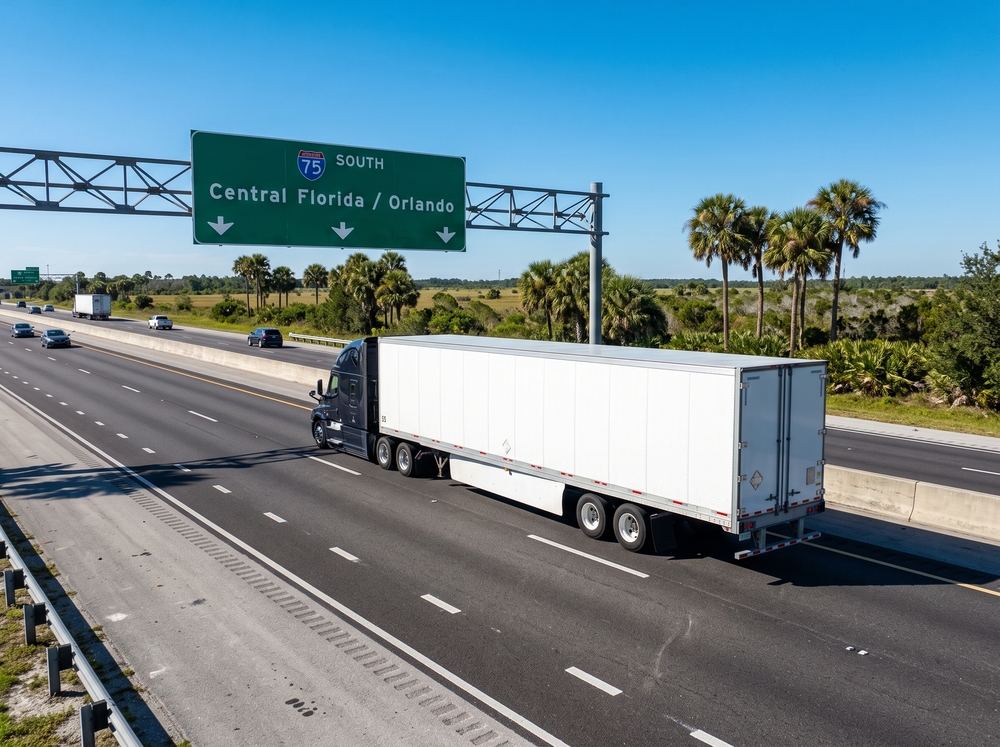
- Less-Than-Truckload (LTL): The most practical option for freight moving between 1 and 6 commercial pallets. Choosing less-than-truckload shipping shares trailer line-haul space across multiple shippers, keeping regional transportation budgets predictable.
- Partial Truckload (PTL): Best suited for 6 to 14 pallets of fragile automotive assemblies, commercial displays, or non-stackable freight. PTL keeps cargo on a single trailer from Michigan to Florida, eliminating intermediate cross-dock re-handling.
- Full Truckload (FTL): For high-volume producers filling a standard 53-foot dry van or refrigerated trailer up to 45,000 lbs. Choose full truckload transport for direct door-to-dock transit reaching Central Florida in roughly 2 business days.
Official Transportation Resources
- Michigan Department of Transportation (Mi Drive Map) — Review real-time Southeast Michigan highway speeds, winter road conditions, and I-75 work zones.
- Florida Department of Transportation (FL511) — Monitor real-time highway speeds, Central Florida turnpike construction alerts, and weather advisories.
- Federal Motor Carrier Safety Administration (FMCSA) — Verify interstate carrier operating authority, safety ratings, and active commercial liability coverage.
Frequently Asked Questions
How long does standard LTL freight take from Dearborn to Apopka?
Standard LTL delivery typically takes 2 to 4 business days. A shipment dispatched from a Dearborn industrial facility on Monday morning generally reaches the Orlando/Apopka regional terminal for delivery between Wednesday afternoon and Friday morning.
Can I arrange liftgate delivery for locations in Apopka?
Yes. If your receiving greenhouse, commercial facility, or warehouse in Apopka lacks an elevated loading dock or forklift, select liftgate delivery during quoting so an equipped local straight truck handles final delivery.
How do I prevent freight re-weigh and classification adjustments?
Accurately measure dimensions from the base of the pallet to the tallest carton point, check for package overhang, and determine the exact density tier using standard freight class guidelines before writing certified scale weights on the Bill of Lading.
Compare Live Rates on the Dearborn to Apopka Lane
Compare real-time rates and line-haul schedules from vetted regional and national carriers running between Metro Detroit and Central Florida.
Compare Live Rates and Book Dearborn to Apopka Freight